Best Practice
Why Dedicated Nearshoring Teams Create Long-term Value
3. June 2025

Digitalisation requires skilled development teams – but many companies experience a shortage of skilled developers locally.
At the same time, IT projects are becoming increasingly complex, increasing the need for stability, business understanding and continuity in the development work.
When it’s difficult to attract and retain the right profiles, many are turning to nearshoring:
Many Danish companies have established long-term, high-performing development teams in Eastern Europe – especially in Ukraine and Poland, where the talent pool is among the strongest in Europe. By collaborating with dedicated teams abroad that are fully integrated into their organisation, they gain not just capacity – but continuity, deep expertise, and a cultural fit that lasts.
Danish companies such as Systematic, Saxo, Spar Nord and Kamstrup have had dedicated nearshoring teams for over a decade, demonstrating the long-term value of the model.

What is a dedicated nearshoring team?
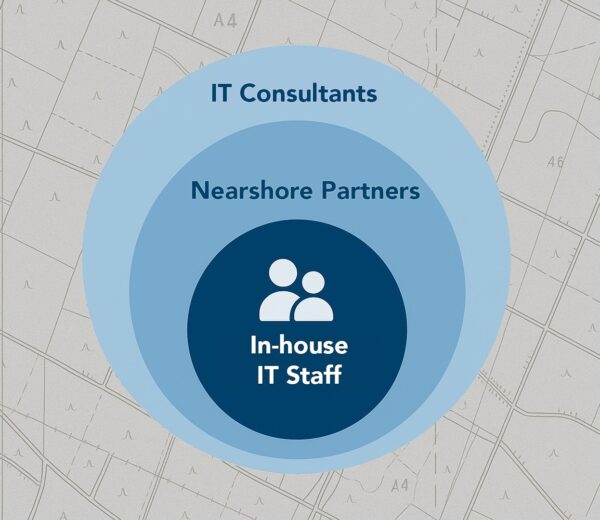
A dedicated nearshoring team is a permanent development team abroad that works exclusively for one company – as an extension of their in-house IT team. The nearshore team is established at our Tech Hubs in Ukraine or Poland. What sets a dedicated team apart is that the developers:
- Working exclusively for you – no context switching or splitting between multiple customers.
- Selected in collaboration with you – you help hand-pick the profiles to match your needs.
- Integrated into your culture – they participate in daily stand-ups, planning, retrospectives and internal events on an equal footing with the rest of the team.
- Located nearby – based in our Tech Hubs in Poland or Ukraine – making it easy to communicate during working hours and visit each other as needed.
In short, you get not just more hands, but a stable team with deep business insight that grows with your organisation and continuously delivers value.
As Rasmus Burkal, Digital Director at Saxo, describes it:
‘We generally don’t distinguish between our internal and external developers. They work on the principle that they are part of Saxo.’
When external developers are considered part of the organisation, it creates a strong foundation for collaboration and ownership.
Below, we dive into five concrete benefits of dedicated nearshoring teams – and why they create long-term value, knowledge building and continuity.

1. Integrated part of your team and culture
One of the biggest benefits of a dedicated team is that it becomes an integrated part of your organisation – even from a distance. The team participates in your processes and communication on a daily basis, building close relationships. The cultural integration means that the developers understand your values, workflows and vision. Over time, they feel like employees on equal footing with those you have locally.
Integration is strengthened by the fact that the team only works for you. They gain in-depth knowledge of your domain, products and goals and can immerse themselves without the distraction of other projects. The result is higher engagement and ownership:
Vibeke Ågren – Head of Software & Analytics explains:
‘ Our solutions are very complex, so continuity and the confidence that our Ukrainian developers are experts in the applications guarantee good quality. ’
When your nearshoring team is integrated in this way, collaboration is smoother, misunderstandings are minimised and everyone works towards common goals.
2. Deeper business understanding and knowledge building
Dedicated teams build a deep business understanding in developers over time. Because they work 100% for you, they get to know your systems, products and industry in detail.
This accumulated domain knowledge makes the team more autonomous and able to make good decisions without constant training or supervision. In other words, their value to the business increases as their knowledge grows – and your ROI increases day by day.
Deep business insight also means that you gain continuity in your development work. Knowledge is not lost after each project or when changing suppliers, as is sometimes the case with short-term outsourcing agreements. On the contrary, know-how stays in the team and with you.
“Conscensia has a good understanding of our needs. It saves us time and ensures continuity in development, which allows us to focus on innovation,’
says Vibeke Ågren, Head of Software and Analytics at Kamstrup.
When developers understand your business, they can better prioritise, think long-term and help develop solutions that support your strategic goals.

3. Proactivity and higher quality development
An integrated, knowledgeable team will often be more proactive. Experience shows that skilled nearshoring developers don’t just passively perform tasks – they actively come up with ideas and suggestions for improvement.
Especially when they understand the business context, they dare to challenge existing solutions and suggest alternative ways to solve problems. This dialogue creates better products in the end because you get multiple perspectives on development tasks.
At Saxo, for example, they have found that the Ukrainian developers contribute input in both small and large contexts:
‘The developers are very proactive and provide input to the development in both small and large contexts. We get exceptionally good output from our Ukrainian developers.’
Rasmus Burkal – Digital Director Saxo explains.
For you as a company, proactive developers mean that you don’t have to discover every challenge or new opportunity yourself – your team helps you stay ahead of the curve. This increases innovation and ensures high quality because potential problems are addressed early and ideas are continuously qualified by the team.
4. Full control and ownership of development
Many choose dedicated teams because it allows you to retain ownership and control of the development work – without compromising on quality. Unlike traditional outsourcing, where external consultants may work for multiple clients and are managed by one supplier, here you have your own team. You decide which developers are involved, you prioritise the day-to-day tasks and the team works according to your processes and methodologies. Development remains closely linked to your business and you have full transparency in your work.
At the same time, all the practicalities of recruitment, contracts, facilities, etc. are taken care of so you can focus on your core tasks. You get the best of both worlds: control over product development, but with less administrative burden. And because the team is dedicated to you in the long term, their skills become part of your organisation – you ‘own’ the know-how, even though the developers are formally employed by the partner. As a result, there is high motivation for the partner to invest in team retention and well-being.
In other words, it’s not just about providing developers, but about ensuring a well-functioning team where people stay and develop. The result is stability: at Conscensia, for example, many of our developers have worked with the same customer for over 10 years. This kind of continuity and ownership of knowledge is difficult to achieve with more fragmented outsourcing models.
“Conscensia should be recognised for the HR function and process they have built. It’s a sourcing partner that does more than provide labour”
says Heidi Pedersen, Vice President at Systematic.

5. Scalability and flexibility – without compromise
Dedicated teams require commitment and investment in collaboration – but the payoff is a stable, productive development team that drives your digital vision forward for the long term.
At Conscensia, we have been working with nearshoring since 2006, and we find that dedicated teams continue to be one of the most effective ways to create the combination of skills, continuity and culture that many Western European companies demand.
Dedicated nearshoring teams address two critical challenges for many businesses: scalability and cost-efficiency. By working with an external partner, you can scale your team up—or down—relatively quickly as your needs change, whether due to peak workloads in development projects or the launch of new initiatives. This allows you to avoid the complex process of hiring and laying off internal staff in response to fluctuating workloads. Nearshoring gives you the ability to expand your capacity in an agile way, while keeping your core team intact.
From a financial perspective, nearshoring offers distinct advantages. Salary levels for developers in Ukraine and Poland are generally lower than in Western Europe, without compromising on skill or expertise.
Combined with an efficient recruitment process and lower costs for things like office space, the impact on your budget can be significant.
“I feel just as confident in Conscensia’s recruitment process as I do with our local HR department in Aarhus,”
says Heidi Pedersen, Vice President at Systematic .
In other words, you can keep costs under control while maintaining a buffer of extra capacity when needed—without sacrificing quality. This flexibility makes you less vulnerable to sudden changes in the market or resource availability.
In short: A dedicated nearshoring team in Ukraine or Poland can become an extension of your development department with integration on culture and processes, deep business knowledge, proactive mindset, control for you as a customer – and the ability to scale and optimize costs. It’s not about a quick-fix solution, but about building a long-term partnership that creates lasting value and innovation.
Getting started is straightforward thanks to our proven collaboration startup process that ensures alignment from day one.
FAQ: Dedicated teams and nearshoring
What is the difference between a dedicated team and traditional outsourcing?
A dedicated team works exclusively for your company and is integrated as part of your own organization. You retain control over day-to-day operations and priorities, while outsourcing often involves external consultants working for multiple customers or managed by the supplier. Dedicated teams provide more ownership, continuity and cultural affinity than classic outsourcing.
Why choose developers in Eastern Europe - what about quality?
Ukraine and Poland educates tens of thousands of engineers and IT specialists every year, and the region is known for high technical expertise. Many developers have extensive experience with international projects and are fluent in English. Quality is on par with Western standards – combined with a strong work ethic and loyalty in long-term collaborations.
How do you deal with time zone and communication?
Denmark and Eastern Europe have a minimal time difference (typically 1 hour), so collaboration takes place during the same working day. Dedicated teams participate in Zoom/Teams, Scrum meetings, daily stand-ups, etc. just like your local colleagues. Many companies also establish regular visits – both your people traveling out and the developers from the nearshoring team regularly visiting the head office. This strengthens relationships and ensures that distance doesn’t become a barrier to a well-functioning team dynamic.
How long does it take to get started with a dedicated team?
Typically, it takes a few weeks to define your needs and starting the recruitment of the right profiles for your team – often faster than finding specialists locally in Western Europe where supply is limited. Therefore, you can see the first developers start within a few months. The onboarding period involves training in your systems and culture, but because the team is dedicated, knowledge building and value creation starts from day one.