Insights
Resource Management and the Use of IT Consultants
23. September 2025
Flexibility Without Breaking the Budget
When companies discuss how to combine external consultants, nearshoring resources, and their own employees, the conversation often becomes an “either–or” debate. In reality, success lies in finding the right mix, and in assigning the right type of resource to the right type of task.
Core competencies and the company’s most critical processes should naturally remain in-house. This is where control, ownership, and security are non-negotiable. Much like in national defense, the most sensitive capacities always stay under direct national control. But around this core, businesses need a flexible system: nearshoring resources to provide scalable support, and external consultants as the last card to play when rare expertise is required.
Below, we look at when each option makes the most sense.
IT Consultants – When Speed Matters Most
Consultants are expensive, but they provide immediate access to highly specialized skills. They are the right choice when the need is urgent and short-term.
The problem arises when consultants are kept on for half a year or more. At that point, the company is paying a premium price for something that could have been better handled through internal staff or nearshore resources.
• Short-term (weeks to a few months): Consultants are worth it, despite the higher hourly cost.
• Long-term (6-12 months): Costs often rise 50-100% higher than alternative solutions, making consultants a poor choice for ongoing roles.
The key rule: the longer the timeframe, the stronger the case for other forms of resourcing.

Nearshoring – The Flexible Solution
Nearshoring strikes a balance between cost, compliance, and collaboration. By working with skilled professionals in nearby countries, companies can scale capacity quickly without the downsides of traditional offshoring.
The financial benefits are clear: nearshoring often reduces costs by 30-40% compared to local consultants. But the real strength lies beyond savings, it’s about building lasting capabilities. Chosing a nearshoring solution will give your business:
• Dedicated Teams: With nearshoring, businesses don’t just “rent” temporary resources. They can establish dedicated teams that grow with the company, understand its culture, and align with long-term goals. Unlike consultants who may leave after a short engagement, nearshore teams provide continuity.
• Domain Knowledge Retention: Over time, nearshore teams accumulate deep knowledge of your systems, processes, and industry. This knowledge stays within the team, ensuring that expertise isn’t lost at the end of a contract. It creates a more stable foundation than the revolving-door model often seen with traditional consulting.
• Integration into the Business: Thanks to overlapping time zones, similar working cultures, and frequent communication, nearshore colleagues can become a true extension of your in-house staff. They join daily stand-ups, use the same tools, and contribute as if they were sitting just a few desks away.
• Scalability and Speed: When demand spikes, a nearshoring partner can ramp up capacity quickly without compromising quality. Conversely, when needs decline, the team can scale down smoothly, avoiding the cost and complexity of local layoffs.
• Access to Specialists: Europe provides a rich pool of highly specialized talent. Having the right expert on the team can accelerate delivery by 30–50% compared to relying solely on generalists, reducing both time-to-value and project risk.
Think of nearshoring as a “standing reserve”: cost-efficient, well-integrated, and always ready to be activated. It strengthens the business not just by lowering costs, but by embedding knowledge, continuity, and collaboration into the organization’s DNA.

Upskilling in-house staff
Investing in your own employees remains a robust long-term strategy. Training and career development ensure that critical knowledge stays within the company, reducing dependency on external resources.
Outcome-Based Models – Paying for Results
Instead of paying for hours, some companies shift to outcome-based contracts, where the supplier is paid for results. This model creates stronger incentives and more predictable budgets, often saving 15–25% compared to time-based billing.
The challenge is that such contracts require more upfront work: clearly defining scope, deliverables, and success criteria. In time-sensitive situations, this preparation can delay execution and sometimes cancel out the savings.
The solution is to involve suppliers early, share responsibility for scoping, and reuse proven standards. That way, businesses can keep speed without losing control.

Building the Right Mix
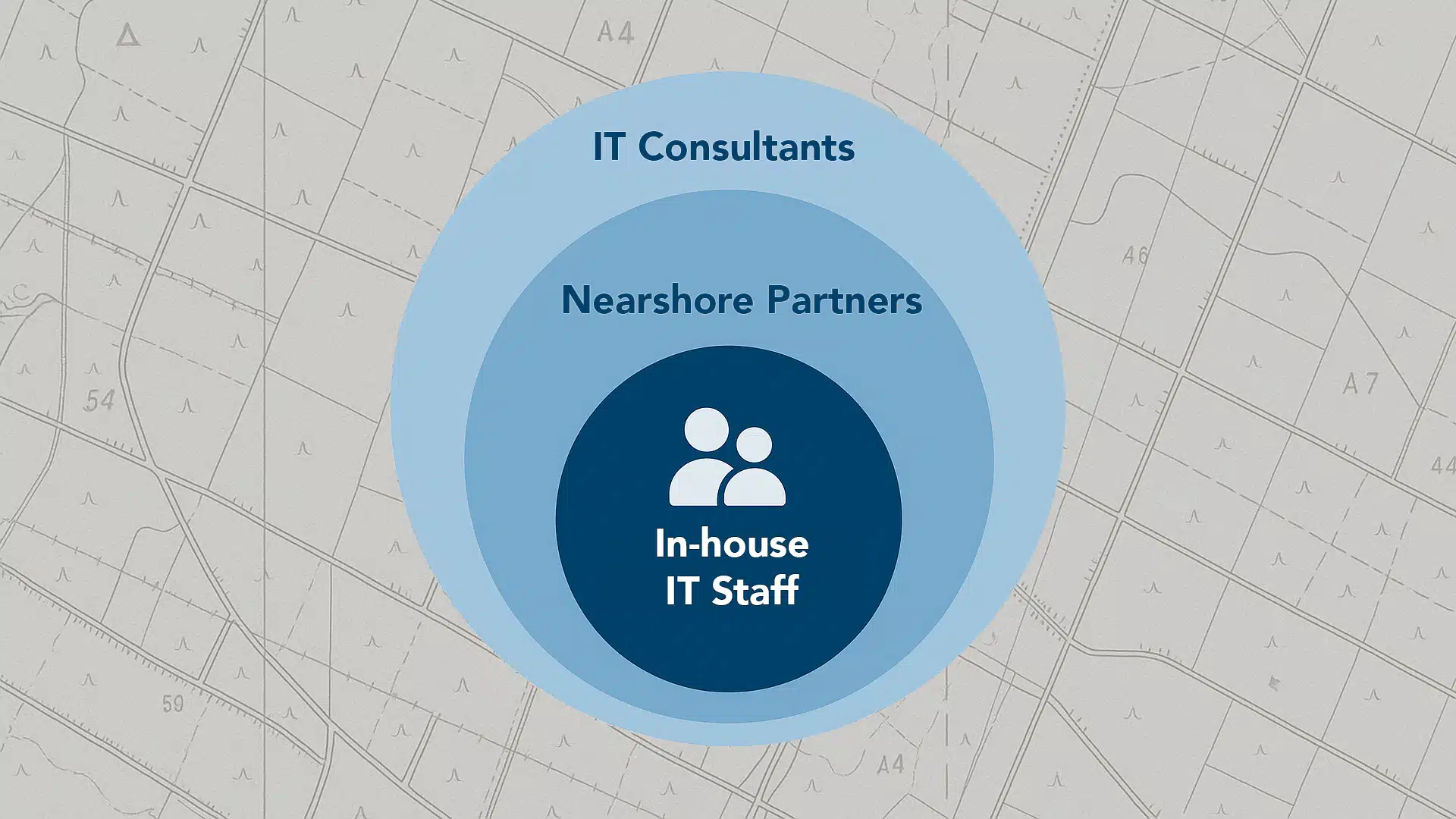
Think of your IT resource management as a layered defense system:
Innermost layer: In-house IT Staff: Carry the core competencies and critical processes. Invest in upskilling and retention for long-term robustness.
Middle layer: Nearshoring partners: Provide flexible scalability and access to niche expertise. They help reduce time-to-value and total costs.
Outer layer: External consultants: Use as a precision tool for urgent needs, short projects, or rare specializations. Where possible, apply outcome-based models to improve cost control and accountability.
Clear governance is essential, each unit must know when and how it is activated. With the right balance, IT organizations gain flexibility, speed, and cost control without compromising ownership or security.